
Quick Answer
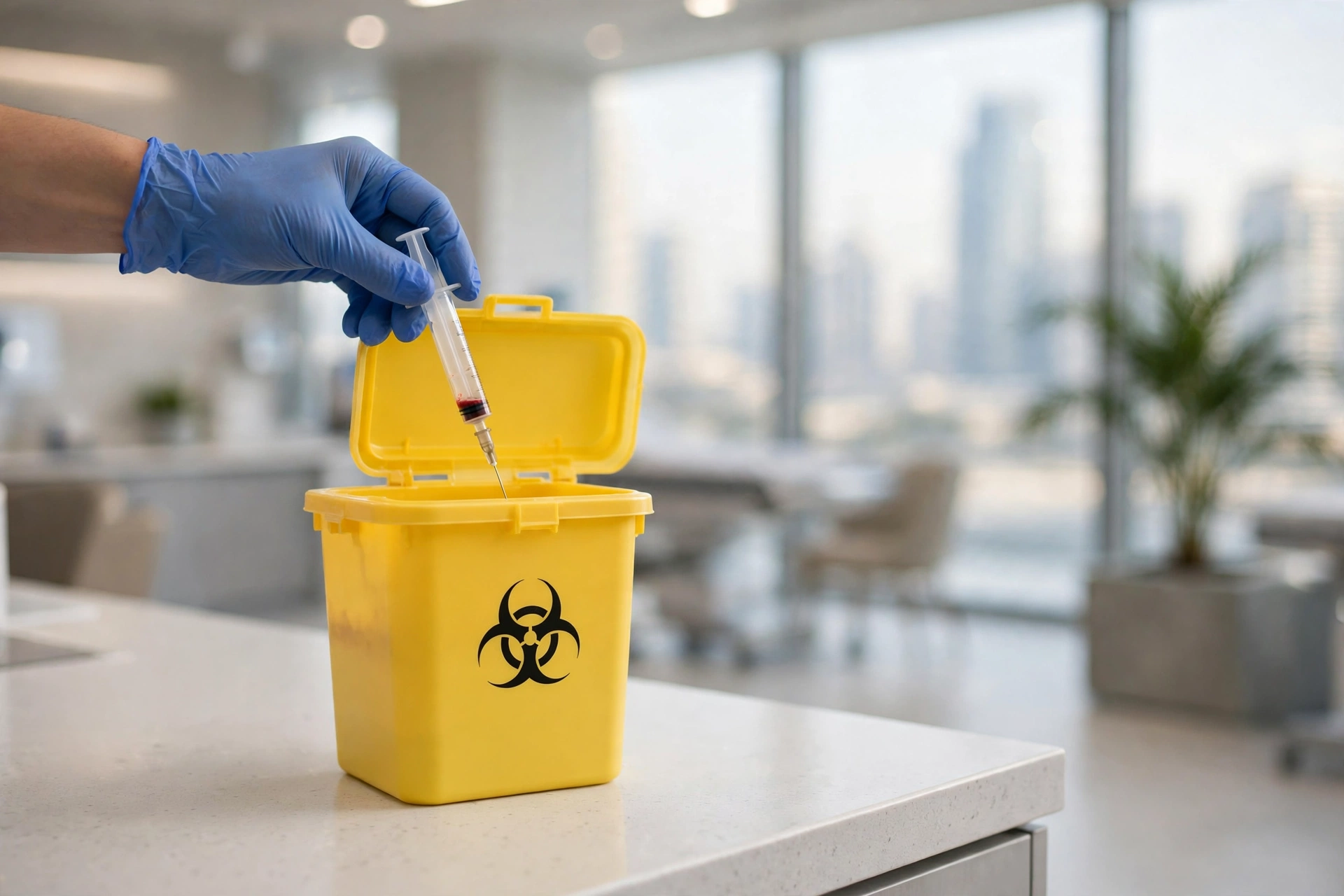
To dispose of sharps waste in Dubai, drop used needles, blades and lancets straight into a rigid, puncture-resistant sharps container. Seal it when it is three-quarters full, store it in a secure area, and hand it to a contractor authorised to collect medical waste. Never place sharps in general or clinical waste bags.
One loose needle in a general waste bag can injure a cleaner, a porter or a landfill worker who never met the patient. That is why sharps are treated as their own category of medical waste, with separate containers, handling rules and collection routines.
If you run a clinic, dental practice, laboratory, pharmacy or aesthetic centre, sharps are part of your daily routine. This guide explains what counts as sharps waste, where facilities usually go wrong, and how to set up a system that protects your team and holds up in an inspection.
What Is Sharps Waste?
Sharps waste is any item that can cut or puncture skin and may carry blood, body fluid or medication residue. Common examples:
- Hypodermic needles and syringes with attached needles
- Scalpel and surgical blades
- Lancets used for glucose testing
- Insulin pen needles and cannulas
- Suture needles
- Broken glass ampoules and vials
- Dental burs, endodontic files and anaesthetic cartridges
- Microscope slides and Pasteur pipettes in laboratories
The item does not need to look dirty. A used needle counts as sharps waste even if it appears clean, because bloodborne pathogens such as hepatitis B, hepatitis C and HIV can survive inside a needle’s hollow bore.
Why Sharps Waste Disposal Matters
Injury prevention. A needlestick injury means blood tests, possible preventive treatment, weeks of worry and sometimes time off work. Most happen during handling or disposal, and most are avoidable.
Legal responsibility. In Dubai, Dubai Municipality oversees waste handling, the Dubai Health Authority regulates licensed health facilities, and the Ministry of Health and Prevention sets federal health sector direction. Medical waste falls under Dubai’s waste framework, which includes Law No. 18 of 2024 and the earlier Local Order No. 115 of 1997 on medical waste.
Reputation and licensing. A failed inspection or a reported injury damages your facility’s standing. Documented, compliant disposal is far easier to defend than a rushed fix after an incident.
Key Benefits of Proper Sharps Disposal
- Safer staff. Fewer injuries and fewer exposure incidents to manage.
- Cleaner inspections. Certificates and collection records are ready when auditors ask.
- No mixed waste. Sharps stay out of general and clinical streams, which keeps those streams simpler and cheaper.
- Predictable costs. Scheduled collection costs less than emergency pick-ups.
- Environmental protection. Sharps never reach landfill or drainage.
Common Problems and Challenges
Overfilled containers. Staff keep pushing needles into a full box to avoid changing it, and needles end up protruding. Dubai Healthcare City guidance says containers should be disposed of when three-quarters full or at the “Full” mark, and never filled above it.
Wrong container placement. A box on a high shelf or across the room encourages staff to carry used needles. Containers belong close to the point of use.
Sharps in the wrong bin. Needles dropped into yellow clinical bags or general bins are a leading cause of downstream injuries. The same guidance lists this among the main causes of sharps injuries.
Recapping by hand. A classic cause of self-injury.
Unsuitable containers. Plastic bottles, food tins and cardboard boxes are not puncture-resistant and are not acceptable substitutes.
No collection records. Many small clinics dispose of waste correctly but cannot prove it when asked.
Important Factors to Consider
Container quality. A sharps container should be rigid, puncture-resistant, leak-proof at the sides and bottom, closable, labelled and marked as biohazard. Match the size to your volume. A dental clinic using a few items a day needs a different container from a vaccination centre.
Volume and frequency. Let fill rate decide the schedule. A busy clinic may need weekly pick-ups, while a small practice may manage with fortnightly or monthly visits.
Storage area. Full containers should wait in a secure, ventilated, access-controlled point, away from patients and general traffic.
The contractor’s permits. Your contractor must be authorised to collect and transport medical waste in Dubai. Dubai Municipality requires hazardous waste transport vehicles to hold a permit, and permitted transporters must use RASID GPS tracking. Ask to see the permit before you sign.
Documentation. Under Dubai’s Duty of Care system, waste must be collected and transported by companies permitted by Dubai Municipality, and transfers of waste are recorded to help with tracking. Keep every collection certificate in one organised file.
Best Practices and Expert Recommendations
- Place the container before the procedure starts. Keep it within arm’s reach, at a stable height, never on the floor.
- Dispose of the sharp immediately. Never leave a used needle on a tray for later.
- Never recap, bend or break needles. If recapping is unavoidable, use a one-handed scoop technique.
- Replace at the three-quarter mark. Make it a fixed rule.
- Lock the lid permanently. A sealed container is never reopened or emptied.
- Label it. Add the facility name, department and sealing date.
- Train every new starter. Include cleaners and housekeeping, who often meet sharps they did not use.
- Keep an incident log. Record near misses, review monthly and move containers where needed.
- Keep waste streams separate. Sharps, clinical waste, pharmaceutical waste and laboratory waste each need their own containers and collection plan. See our guide on pharmaceutical waste disposal and our laboratory waste service.
For the wider regulatory picture, read our guide on medical waste disposal rules.
How Professional Sharps Waste Services Help
Handling sharps in-house sounds simple until you list the tasks: sourcing containers, scheduling pick-ups, storing full boxes, arranging transport and keeping paperwork. A professional service removes most of that load.
A good provider will:
- Supply or advise on suitable containers
- Collect on a fixed schedule or on demand
- Transport sealed containers in suitable vehicles
- Hand over documentation after each collection
- Tell you when your volume no longer matches your container size or schedule
The biggest gain is time. Nurses and clinic managers spend it on patients instead of chasing contractors.
Why Choose Globalex for Sharps Waste Collection
Globalex is a Dubai group with its office in Al Nahda, serving clinics, hospitals, laboratories and pharmacies across the city. Our sharp waste disposal service sits within a wider medical waste collection service, so one provider can handle your sharps, clinical waste, pharmaceutical and laboratory streams.
What clients value:
- Licensed and insured crews who collect sealed containers without opening or handling the contents
- A certificate after every job, so your records stay complete
- Same-day response on weekdays for urgent collections
- One point of contact for every medical waste stream
- Clear quotes before work begins, with no surprise charges
- Availability 24 hours, Monday to Saturday
Areas near our office, including Al Nahda, Al Qusais, Deira and Mirdif, are the quickest to reach. See our page on medical waste collection in Deira for local coverage.
Our Service Process
- Tell us your needs. Call or WhatsApp with your facility type, location and the number of containers.
- Get a clear quote. We confirm scope, frequency and price before anything starts.
- Collection. Our crew arrives at the agreed time, collects sealed containers and replaces them where needed.
- Documentation. You receive a certificate for each collection.
- Schedule review. For regular clients we set a repeat schedule and adjust it as volume changes.
Frequently Asked Questions
How do you dispose of sharps waste in Dubai?
Place used needles, blades and lancets in a rigid, puncture-resistant sharps container immediately after use. Seal it at the three-quarter mark, store it securely, and hand it to a contractor authorised to collect medical waste in Dubai.
Can I throw sharps in the normal bin?
No. Sharps in general or clinical waste bags can injure waste handlers and spread infection. They must go into a dedicated sharps container and then into a medical waste collection stream.
When should a sharps container be replaced?
When it is about three-quarters full or reaches the fill line marked on it. Never force more items in, and never empty or reopen a sealed container.
How should people with diabetes dispose of lancets and pen needles at home?
Use a proper sharps container, not a plastic bottle in household rubbish. If you need help arranging disposal, contact us and we will advise on the right option.
How often should sharps waste be collected?
It depends on volume. High-volume facilities may need weekly collection, while smaller practices often manage with fortnightly or monthly visits. Container fill rate should decide, not the calendar.
What is the difference between sharps waste and clinical waste?
Sharps waste is anything that can cut or puncture skin, such as needles and blades. Clinical waste covers items like dressings, swabs and PPE. They use different containers and are collected separately.
Conclusion
Sharps are a small share of your waste by weight but cause a large share of injuries. A suitable container in the right place, a firm replacement rule, trained staff and a reliable licensed collector protect your team and keep your records clean.
Ready to Arrange Sharps Waste Collection?
Whether you run a single clinic or a multi-site healthcare group, Globalex can set up a collection plan that fits your volume.
Call: +971 55 928 6666
WhatsApp: https://wa.me/971559286666
Email: gm@globalex.ae
Office: Mai Tower, Office 1501, Al Nahda 1, Dubai
Request a free quote today and get a clear price before any work begins.
Pingback: How to Dispose of Pharmaceutical Waste in Dubai: Guide