
Medical waste is the broad term for all waste produced by healthcare activity, including sharps, pharmaceutical, laboratory and anatomical waste. Clinical waste is the part of it that comes from patient care and may be infectious, such as used dressings, swabs, gloves and contaminated PPE. In Dubai the official term is “medical waste”, and every type must be separated at source and collected by a Dubai Municipality-approved contractor.
Ask ten clinic managers whether they produce “clinical waste” or “medical waste” and you will get mixed answers. Most use the two terms for the same thing. That is understandable, but it causes real problems when a facility has to decide which bin an item goes into or what to tell a waste contractor.
This guide explains how the two terms relate, what falls into each group, and how to keep them properly separated in a Dubai clinic, dental practice, laboratory or hospital.
What Is Medical Waste?
Medical waste is the umbrella term. It covers any waste generated by diagnosing, treating or preventing disease in humans or animals, along with related research. Dubai’s regulatory framework uses this term. Dubai Municipality’s technical guidance refers to Local Order No. 115 of 1997 concerning medical waste management in the Emirate of Dubai and an accompanying code of practice for hospitals, clinics and related premises.
Medical waste includes:
- clinical waste from patient care
- Sharps such as needles, blades and lancets
- Pharmaceutical waste such as expired and unused medicines
- Laboratory waste such as cultures, samples and contaminated consumables
- Anatomical and pathological waste such as tissue
- Chemical waste such as disinfectants and reagents
- Radioactive waste from nuclear medicine, which follows its own strict rules
What Is Clinical Waste?
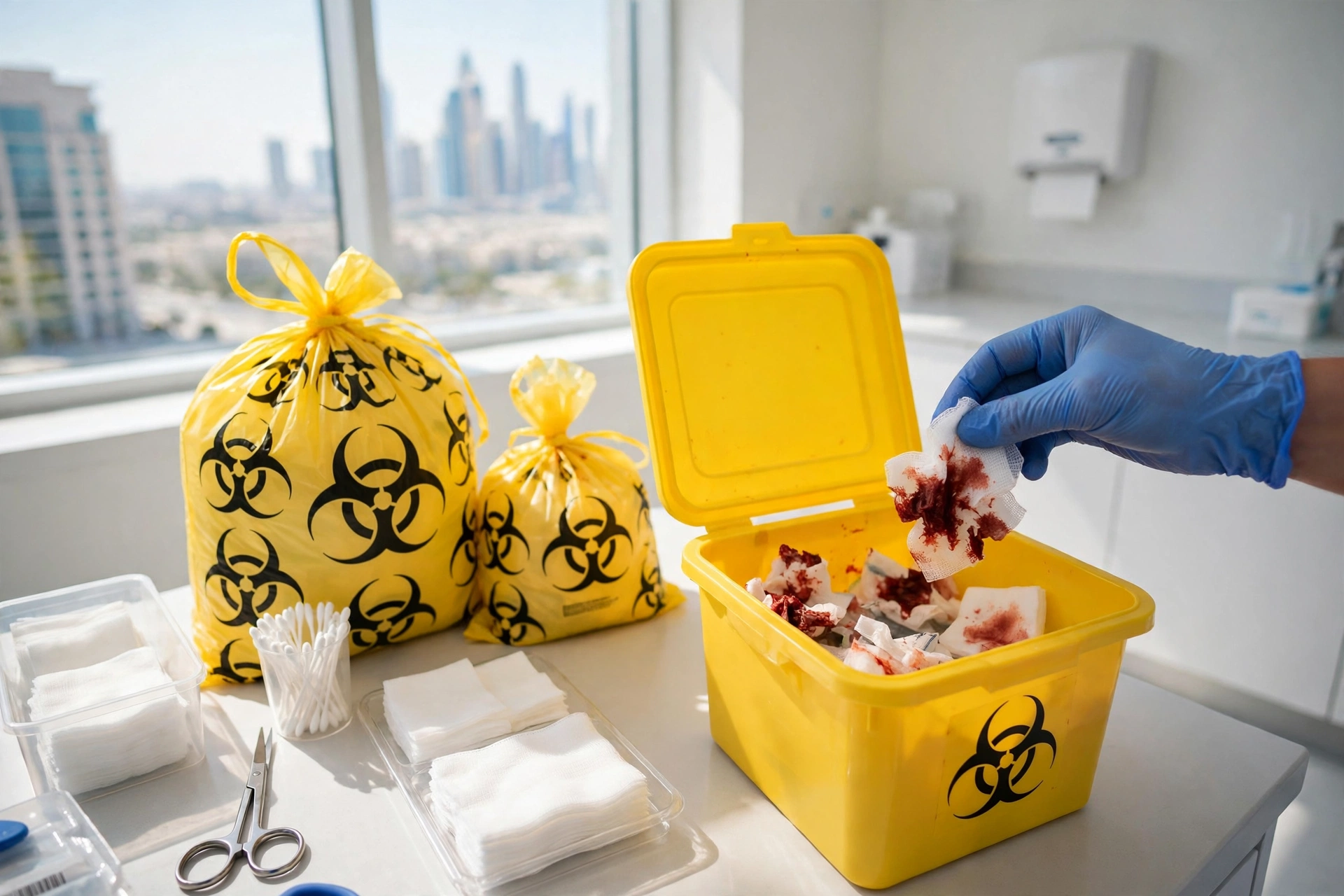
Clinical waste is waste from patient care that carries an infection risk or could cause harm if handled like ordinary rubbish. Common examples:
- Used dressings, bandages and swabs
- Gloves, aprons and masks contaminated with blood or body fluids
- Disposable drapes and gowns from procedures
- Catheters, drains and tubing
- Blood-soaked gauze and cotton
- Dental waste contaminated with saliva or blood
- Specimen containers and waste from wound care
Some sources use “clinical waste” and “healthcare waste” as near-synonyms. Others use “medical waste” for the whole category and “clinical waste” for the infectious portion. The second usage is the most practical, and it is the one we use in this article.
Clinical Waste vs Medical Waste: The Key Differences
| Aspect | Medical waste | Clinical waste |
|---|---|---|
| Scope | All healthcare waste streams | Patient-care waste with infection risk |
| Includes sharps? | Yes | Usually handled separately |
| Includes medicines? | Yes | No, handled as pharmaceutical waste |
| Includes lab waste? | Yes | Some overlap, but handled separately |
| Typical examples | Needles, medicines, tissue, reagents, dressings | Dressings, swabs, contaminated PPE |
| Dubai term | Official regulatory term | Practical term for one stream |
In short, every piece of clinical waste is medical waste. Not every piece of medical waste is clinical waste.
Why the Distinction Matters
Safer handling. Each stream carries a different hazard. Sharps cut, medicines poison, chemicals burn, and infectious dressings spread disease. A single bin for everything protects against none of them.
Correct disposal route. Different streams go to different treatment. Dubai’s medical waste goes to licensed incineration, and a mixed bag can force the whole load into the most expensive route.
Compliance. Dubai Municipality classifies its solid waste into seven categories. Medical waste must stay out of general waste. Mixing streams is a common reason facilities fail inspections.
Cost control. General waste is cheap to dispose of. Medical waste is not. If staff throw general rubbish such as paper, packaging and food waste into the clinical bin, you pay medical-waste prices for ordinary rubbish.
Common Problems and Challenges
Over-use of the infectious bin. Staff throw everything into the yellow bag “to be safe”. The facility ends up paying for far more infectious waste than it really generates.
Under-use of it. The opposite error is worse: a blood-soaked dressing in a normal bin.
Sharps in bags. Needles in a clinical waste bag are a major source of injuries to the people who carry it.
Medicines in clinical bags. Expired medicines need their own stream.
Unclear colour codes. Bin colours differ between systems and authorities. Staff who have worked abroad may follow the colour code they learned elsewhere.
No training for housekeeping. Cleaners often handle bags without knowing what is inside.
Important Factors to Consider
Colour coding. Colour systems vary between regulators. For example, an Abu Dhabi health policy based on federal regulation specifies red bags for anatomical and pathological waste and yellow boxes for sharp objects. Dubai Healthcare City’s policy uses yellow for other medical wastes. Follow the system required by your facility’s licensing authority and confirm it with your contractor.
Biohazard labelling. Medical waste packaging should carry the biohazard symbol and clear labels showing the facility and date.
Bag and container quality. Use heavy-duty, leak-resistant bags and rigid containers where required. A thin bag that tears in the corridor undoes all your good segregation.
Storage. Keep a secure, ventilated, access-controlled storage area for sealed bags, away from patients and general bins. The DHA’s health facility design guidance includes dedicated waste storage space for clinical waste in its waste management unit requirements.
Contractor approval. Only use providers approved by Dubai Municipality. A health and safety guideline summarising Dubai rules states that only Dubai Municipality approved providers should be used to collect waste, and disposal records should be kept.
Best Practices and Expert Recommendations
- Segregate at the point of use. Place the right bin in the treatment room before the procedure starts.
- Put a colour and content poster above every bin. Staff should not have to guess.
- Never overfill bags. Seal at about three-quarters full and tie securely.
- Keep general rubbish out. Paper, packaging, food and clean plastic belong in general waste.
- Keep sharps in sharps container, always
- Keep medicines, chemicals and lab waste in their own streams.
- Label bags with facility name, date and department.
- Move waste on a set route and schedule. Avoid carrying open bags through patient areas.
- Train every new starter, including cleaners.
- File every collection certificate.
For the wider regulatory picture, read our guide to medical waste disposal rules every Dubai clinic must know.
How Professional Medical Waste Services Help
Segregation starts in your own rooms, but collection, transport and treatment are specialist jobs. A professional contractor helps you:
- Match the right container to each waste stream
- Collect on a fixed schedule or on demand
- Transport sealed waste in suitable vehicles
- Provide a certificate after each collection
- Review volumes and cut cost by spotting over-use of the infectious bin
A good contractor will also tell you, politely, when your staff are putting the wrong items in the wrong bags.
Why Choose Globalex for Clinical and Medical Waste Collection
Globalex is a Dubai group with its office in Al Nahda, serving clinics, hospitals, laboratories and pharmacies across the city. Our clinical waste service sits inside a wider medical waste service that also covers sharps, pharmaceutical and laboratory waste, so one provider can manage every stream.
What clients value:
- Licensed and insured crews trained in safe handling
- A certificate after every job, ready for audits
- Same-day response on weekdays for urgent collections
- One contract and one contact for all medical waste streams
- Clear quotes before work begins, with no surprise charges
- Availability 24 hours, Monday to Saturday
Al Nahda, Al Qusais, Deira and Mirdif are the quickest areas for us to reach. See our page on medical waste collection in Deira for local coverage.
Our Service Process
- Tell us about your facility. Call or WhatsApp with your location, type of practice and the waste streams you produce (contact us).
- Get a clear quote. We confirm scope, frequency and price before work starts.
- Collection. Our crew arrives on time, collects sealed waste and replaces bags and containers as agreed.
- Documentation. You receive a certificate for each collection.
- Review. We check your volumes at intervals and adjust the schedule as your needs change.
Frequently Asked Questions
What is the difference between clinical waste and medical waste?
Medical waste is the broad term for all waste produced by healthcare activity, including sharps, medicines, laboratory waste and tissue. Clinical waste is the portion that comes from patient care and may carry infection, such as dressings, swabs and contaminated PPE.
Is clinical waste the same as medical waste in Dubai?
In everyday use, people often treat them as the same thing. Officially, Dubai regulations use the term medical waste, and clinical waste is one stream within it.
Is a used plaster or bandage clinical waste?
If it is contaminated with blood or body fluids, treat it as clinical waste. Clean, unsoiled packaging or wrappers belong in general waste.
Can I put sharps in a clinical waste bag?
No. Sharps need a rigid, puncture-resistant sharps container. A needle in a bag can injure anyone who handles it.
Where does PPE go?
PPE contaminated with blood or body fluids goes in clinical waste. Clean PPE used in non-infectious settings can usually go in general waste. When in doubt, follow your infection control policy.
Who can collect medical waste in Dubai?
Only a contractor approved by Dubai Municipality. Ask to see their approval and keep a certificate for every collection.
Conclusion
The words matter less than the habit behind them. Separate waste at the point of use, keep sharps, medicines, chemicals and infectious waste apart, and use a contractor you can verify. Your staff stay safer, your inspections go smoother, and you stop paying medical-waste prices for ordinary rubbish.
Ready to Arrange Clinical and Medical Waste Collection?
Whether you run a single clinic or a multi-site healthcare group, Globalex can set up a collection plan that fits your volume.
Call: +971 55 928 6666
WhatsApp: https://wa.me/971559286666
Email: gm@globalex.ae
Office: Mai Tower, Office 1501, Al Nahda 1, Dubai
Request a free quote today and get a clear price before any work begins.